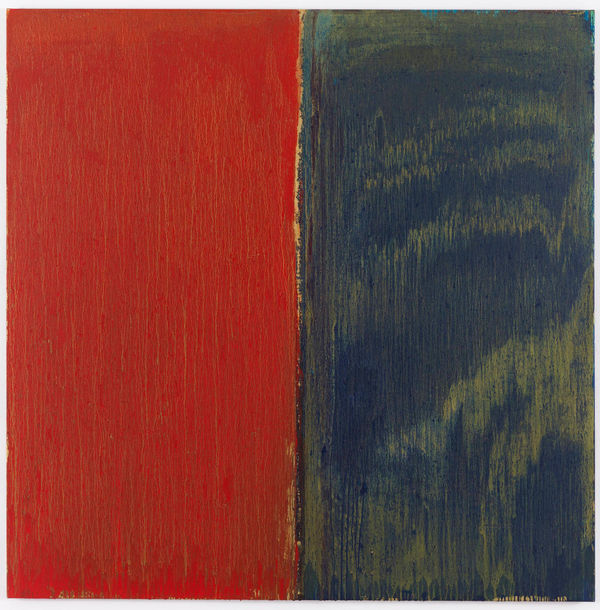
Pat Steir (b. 1938) is a pioneering American painter whose five-decade career has reshaped contemporary abstraction. Known for her signature Waterfall paintings—made by pouring pigment and allowing gravity, time, and controlled chance to direct the flow—Steir creates works that bridge Eastern philosophy, art history, and conceptual rigor. Her practice, rooted in an embrace of both intention and accident, has made her one of the most influential artists of her generation.
Born in Newark, New Jersey, Steir studied at Pratt Institute and Boston University, where she cultivated an early interest in philosophy and developed formative relationships with artists such as Sol LeWitt, Brice Marden, and Lawrence Weiner. By the early 1960s she was already exhibiting in major museum group shows at the High Museum of Art, the Philadelphia Museum of Art, and the Museum of Modern Art, placing her among the first women to gain visibility in New York’s male-dominated art scene.
In the 1970s Steir balanced teaching, publishing, and artmaking. She served as Art Director at Harper & Row, taught at Parsons and CalArts—where she mentored artists including Ross Bleckner and David Salle—and helped found both Printed Matter and the feminist journal Heresies. During this period she developed her early emblematic series, including her crossed-out rose paintings and large-scale wall drawings that merged painting, installation, and perceptual experience.
Steir’s friendships with John Cage and Agnes Martin were pivotal to her evolution. Cage’s embrace of chance and Martin’s meditative restraint deepened Steir’s interest in process and non-intention. Her travels to Japan and China in the 1980s further expanded her visual vocabulary, drawing her toward Shan shui landscape traditions that evoke nature rather than depict it.
By the late 1980s Steir developed the poured-paint technique that would define her mature work. These paintings—at once atmospheric, monumental, and rooted in controlled unpredictability—exist as their own environments rather than representations. Blending conceptualism, minimalism, and abstraction, Steir continues to explore the relationship between control and chaos, maintaining a practice that remains expansive, experimental, and profoundly influential.